How Carpet Measuring Works Before You Buy
See how carpet measuring works at home, from doorways and awkward corners to fitting allowance, so you can choose confidently and avoid costly waste.
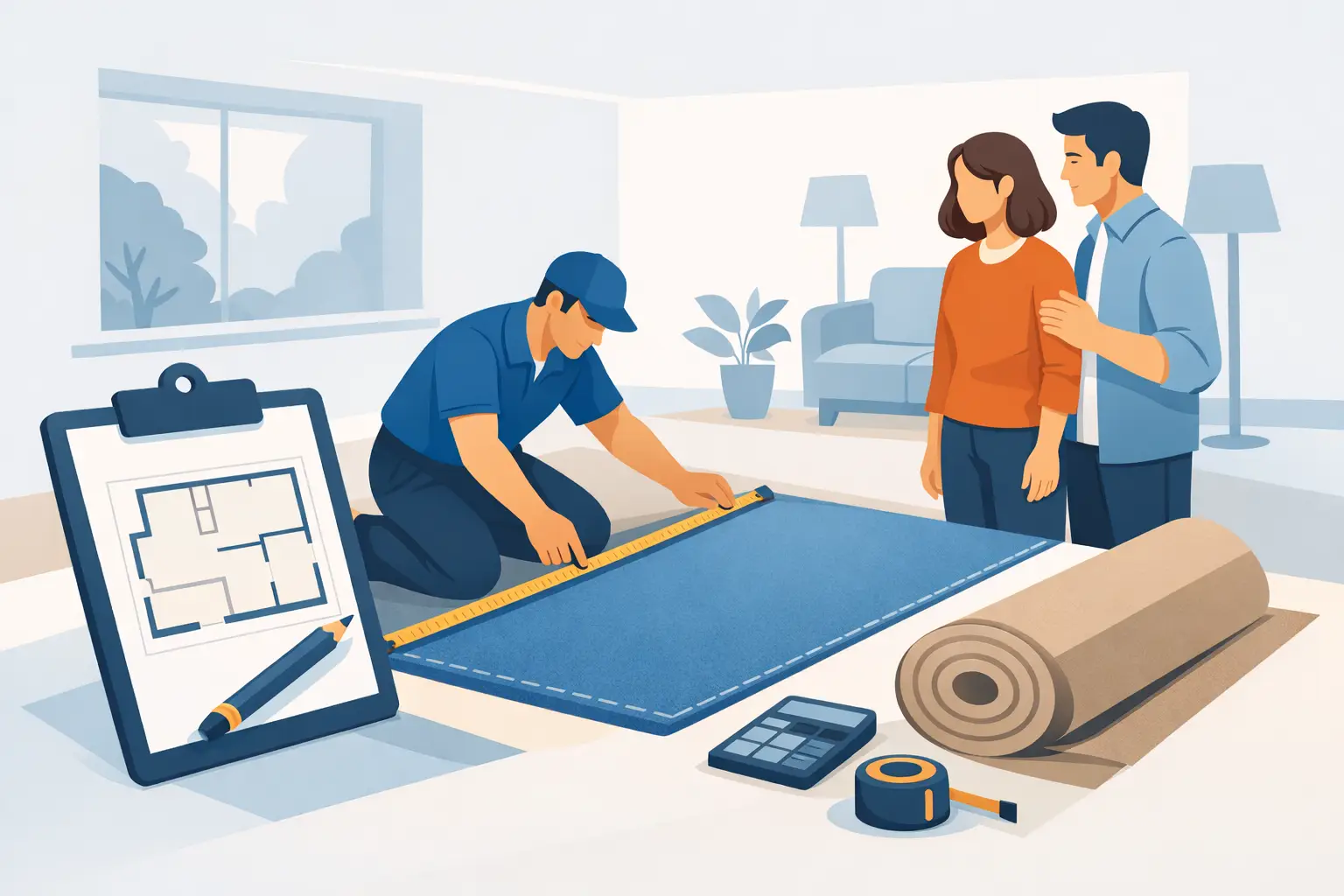
A room can look like a simple rectangle until you start measuring around a chimney breast, bay window or open doorway. That is why understanding how carpet measuring works can save you from ordering too little, paying for unnecessary waste, or ending up with a join where you really did not want one. The good news is that you do not need to become a flooring expert - a proper home measure makes the whole decision much easier.
How carpet measuring works in real homes
Carpet is usually sold by the square metre, but it is not cut from an unlimited sheet in any shape you like. It comes on a roll at a fixed width, most commonly four or five metres. Your fitter needs to work out how the room can be cut from that roll while allowing for trimming, pattern matching and sensible placement of any joins.
This is why simply multiplying the room length by its width gives only a starting point. A 3.6m by 4m bedroom, for example, has a floor area of 14.4m². But if the carpet is supplied in a 4m width, the order may need to be 4m by 3.7m or 3.8m to allow a little extra for accurate cutting and fitting. The final quantity is based on the roll plan, not just the floor area shown on a tape measure.
At a home visit, the room is measured at several points rather than once across the middle. Walls are not always perfectly straight, alcoves can be deeper than they appear, and older Norfolk homes are particularly good at hiding a slightly unusual corner. Measuring the widest and longest points helps make sure the carpet reaches every edge after it has been trimmed neatly into place.
Why fitting allowance is included
Carpet needs a small amount of excess around the perimeter. This is called fitting allowance. It gives the fitter enough material to cut accurately against skirting boards, tuck the carpet into gripper rods and deal with walls that are a touch out of square.
That allowance is not waste caused by poor measuring. It is part of getting a clean, secure finish. Trying to order carpet to the exact millimetre can leave no room for adjustment, which is a false economy if the carpet ends up short on one wall.
Doorways, alcoves and bay windows
The details around a room are where careful measuring really earns its keep. A recessed doorway may need carpet to continue beyond the main rectangle, while an alcove can affect the most efficient way to cut the piece. Bay windows are measured as individual sections so the fitter can plan the shape properly rather than guess from a single overall dimension.
Open-plan spaces need thought too. You may prefer one continuous piece of carpet through a lounge and dining area, but that depends on the roll width, room layout and how much extra material the plan requires. Sometimes a discreet join is the better-value choice. There is no one-size-fits-all answer - the right option balances appearance, practicality and budget.
Roll widths, joins and carpet direction
The direction in which carpet is laid matters as much as the room dimensions. Most carpets have a pile direction, often called the nap. When you brush it one way, it may look slightly lighter or darker. A professional plan keeps the pile running consistently through the main area so the finished floor looks even.
Joins are sometimes unavoidable, especially in wider rooms or spaces with an awkward shape. Where possible, they are planned away from obvious sightlines and heavy traffic routes. A join across the middle of a bright, open living room may be more noticeable than one placed near the edge of a room or beneath furniture.
Patterned carpets require extra care. Stripes, checks and repeating designs must line up across any join, which means ordering extra material for pattern matching. The larger or bolder the repeat, the more allowance may be needed. This is worth knowing before falling in love with a patterned option for a particularly large room.
For plain twist or Saxony carpets, the planning is often more straightforward, though pile direction still matters. Loop carpets and natural styles may have their own fitting considerations, particularly around seams and edges. Your choice of carpet is never just about colour or softness underfoot - the room shape can affect the most sensible option too.
What a professional carpet measure checks
A free home measure is about more than taking dimensions. It gives you a clear picture of what is needed before you commit. The person measuring will look at the floor itself, the route into the room and the small details that can affect fitting day.
They will check whether the existing gripper rods can be reused or need replacing, whether underlay is suitable, and whether doors may need easing after a new carpet and underlay are fitted. They can also identify thresholds between carpet and another floor covering, such as vinyl in a kitchen or LVT in a hallway.
Stairs are measured separately because every tread, riser, winding step and landing needs to be accounted for. A staircase can use more carpet than homeowners expect, especially when the pattern or pile direction needs to run in a particular way. This is another area where a quick estimate based on floor area can be misleading.
The condition of the subfloor matters as well. Carpet can feel wonderfully cosy, but it will not hide every dip, loose floorboard or uneven section beneath it. Flagging any preparation work early means your quote is clearer and there are fewer unwelcome surprises later.
Measuring helps you compare carpet properly
When you see a carpet price per square metre, it is natural to multiply it by your room area. That is useful for a rough budget, but the full cost also depends on the roll plan, underlay, grippers, door bars, delivery and fitting. A transparent quote should set these out clearly, so you can see what you are paying for.
It is also why comparing two carpets on price alone can be misleading. A five-metre-wide carpet might create less offcut in one room than a four-metre-wide alternative, even if its price per square metre is slightly higher. Equally, a more affordable carpet may be the better fit for a spare bedroom where durability demands are lower.
Seeing samples at home makes this part easier. Daylight, lamp light, existing furniture and wall colours all change how a carpet feels in the room. A pale shade that looks perfect in a showroom can appear cooler in a north-facing bedroom, while a textured neutral may be more forgiving in a busy family lounge. Measure first, then choose with the actual room in front of you.
How to prepare for your home measure
You do not need to empty every room before someone comes to measure. It helps, though, if the main edges of the floor and any awkward areas are reasonably accessible. Mention anything you are unsure about, such as furniture you would like left in place, a loose threshold, pets, parking or a room that is being redecorated.
If you are choosing carpet for more than one room, say whether you want the same style throughout. Planning several spaces together can sometimes make better use of a roll, although it depends on their sizes, shapes and the carpet selected. Your adviser can explain the options in plain English, without the showroom pressure.
For landlords, accurate measuring is especially useful when timing matters between tenancies. A planned measure and clear quotation help you organise the work quickly, while still choosing a hard-wearing carpet that suits the property and budget.
Cosy Carpets & Flooring brings samples and measuring expertise to homes across Norfolk, so you can assess the flooring where it will actually live. You can ask questions as you go, compare colours against your décor and receive a quote based on a proper fitting plan rather than a hopeful estimate.
The best carpet choice is the one that looks right, feels right and fits right. Start with a proper measure, and you can make the rest of the decision with far more confidence - then get cosy while the fitting is handled for you.